
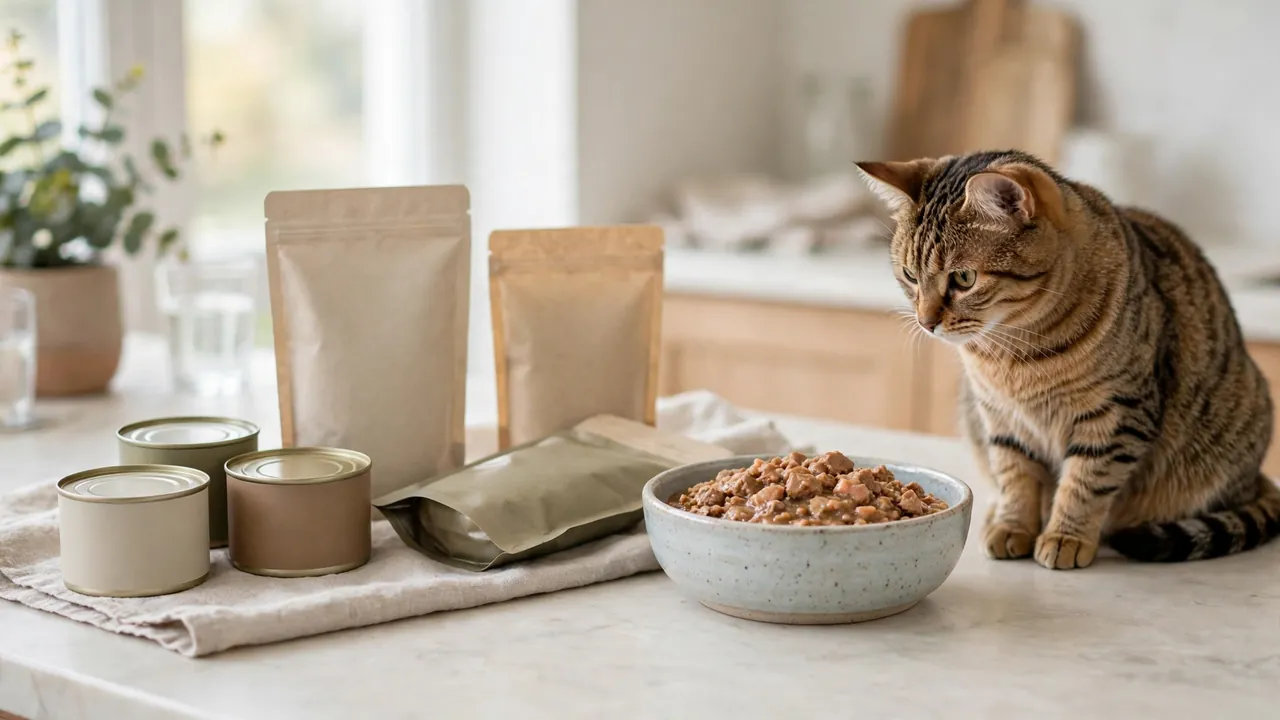
If there’s one upgrade that improves almost every cat’s health, it’s feeding more wet food. Cats evolved as desert animals with a low thirst drive — they’re designed to get moisture from prey, not from a water bowl. A cat eating only dry kibble lives in a state of mild chronic dehydration, which is linked to urinary and kidney problems down the track. The best wet cat food Australia 2026 has to offer isn’t necessarily the most expensive tin on the shelf; it’s the one with real meat first, complete-and-balanced nutrition, and a price you can sustain every day.
This guide explains what to look for on labels, our top picks across budgets and life stages with honest Australian pricing, how much to feed, and the transition tricks for kibble-addicted cats. Prices are November 2026 snapshots — check current retail before buying. If you feed a mix of wet and dry, our best cat food Australia 2026 roundup covers the dry side of the bowl.
Why Wet Food Matters: The Hydration Case
Wet food is roughly 75–80% water; dry food is about 10%. A cat eating wet food can take in double or triple the daily moisture of a kibble-fed cat without drinking a drop extra. That matters because:
- Urinary health: dilute urine means fewer crystals and less cystitis — one of the most common (and painful) reasons cats visit emergency vets.
- Kidney support: chronic kidney disease is the leading age-related illness in cats; lifelong good hydration is the best prevention available.
- Weight control: wet food’s volume-to-calorie ratio helps cats feel full on fewer calories — genuinely useful for the 40%+ of Australian cats estimated to be overweight.
The ideal is wet food as the dietary base with quality dry food as a supplement (or vice versa for grazers), plus fresh water always available. For senior cats especially, wet food should dominate the bowl.
How to Read a Cat Food Label: 5 Rules
- “Complete and balanced” is non-negotiable. In Australia, look for a statement that the food meets AAFCO (or FEDIAF) nutrient profiles for the stated life stage. “Complementary” or “treat” foods are fine as toppers, not as the diet.
- Named meat first. “Chicken”, “tuna”, “lamb” — not “meat and animal derivatives” or “poultry by-products”. The first ingredient should be an animal protein your cat would recognise.
- Match the life stage. Kitten, adult, senior — nutrient profiles differ (kittens need more protein, fat and DHA). “All life stages” foods meet kitten requirements, which is fine for adults too.
- Watch the jelly-to-meat ratio. Some budget tins are mostly gravy with meat flakes. Higher meat content generally means better nutrition per dollar, even at a higher sticker price.
- Ignore the front, read the back. “Gourmet”, “natural” and “premium” are marketing terms with no legal meaning in pet food. The guaranteed analysis and ingredient list are the truth.
Best Wet Cat Food Australia 2026: Top Picks
Best overall premium: Ziwi Peak & Feline Natural (NZ-made, widely stocked in AU)
These New Zealand brands set the bar: 92%+ meat, organs and bone, no grains, no carrageenan, ethically sourced proteins including novel options (venison, brushtail, green-lipped mussel). Ziwi Peak’s air-dried-adjacent wet recipes and Feline Natural’s BPA-free cans are vet-respected and cat-adored. The catch is price — expect around $6 or more per day for an average cat (a 185g can is about $6.19 at Petstock), putting them in the “supplement the rotation” tier for many budgets. Available at Pet Circle, My Pet Warehouse and specialty retailers.
Best mid-range all-rounder: Hill’s Science Diet & Royal Canin wet
The vet-clinic staples earn their place through decades of feeding trials and precise life-stage formulations — kitten, adult, senior 7+, urinary care, weight management. A 12-pack of Hill’s or Royal Canin pouches typically runs $34–$40 at Australian online pet stores, working out to roughly $3 a pouch — about $6–$9 a day for a cat eating 2–3 pouches. If your cat has a medical condition, these brands’ prescription wet diets (available through vets) are the gold standard.
Best supermarket premium: Fancy Feast & Whiskas wet ranges
Don’t dismiss the supermarket aisle entirely. Fancy Feast Classic (the pâté lines, not the gravy-heavy ones) offers surprisingly decent meat content for around $1–$1.50 per tin (about $1.20 at Woolworths and Coles), and Whiskas’ Australian-made wet range is complete and balanced at a similar price — a 12-pack of 85g pouches is about $13 at Woolworths and Coles. For multi-cat households where premium tins would cost $200+/month, these are honest, sustainable daily drivers. Rotate proteins to cover nutritional variety.
Best budget: Coles/Woolworths home-brand and Dine
Home-brand complete wet foods (often under $1 a pouch in multi-packs) meet the same AAFCO complete-and-balanced standard as foods five times the price — the standard is a floor, not a ranking, but it’s a meaningful floor. Dine’s Australian-made range sits between budget and mid-tier. If budget is the constraint, a complete budget wet food beats a premium dry food for hydration every time. Work the monthly cost into your budget with our pet cost calculator.
Best for kittens: Royal Canin Kitten / Hill’s Kitten wet
Kitten-specific wet foods pack the extra protein, fat, DHA and calcium growing bodies need. Feed kitten formula until 12 months (large breeds: longer — ask your vet), and don’t ration: kittens self-regulate well when fed 3–4 small wet meals daily. Pair with your kitten’s vaccination schedule so nutrition and prevention grow together.
Best for seniors: Hill’s 11+ / Royal Canin Ageing 12+ wet
Senior formulas adjust phosphorus (kidney kindness), add omega-3s and antioxidants, and use softer textures for worn teeth. For cats with diagnosed kidney disease, prescription renal wet diets genuinely extend quality life — but they must be vet-prescribed and monitored.
How Much Wet Food Per Day?
An average 4–5kg adult cat needs roughly 200–250 calories daily (less if desexed and indoor — desexed cats need ~20% fewer calories). A typical 85g pouch holds 70–90 calories, so most cats need 2–3 pouches or one 400g tin-ish equivalent per day, split into two meals. But the packet guidelines are starting points, not prescriptions: weigh your cat monthly and adjust so the ribs are easily felt under a light fat cover (body condition score 4–5/9). Kittens: feed 3–4 times daily and let appetite lead. Always transition foods over 7–10 days to avoid tummy upsets. The feeding maths above applies to any of the best wet cat food Australia 2026 picks in this guide — premium or budget.
The Kibble Addict: Transitioning to Wet Food
Some cats — especially those raised exclusively on dry food — treat wet food with suspicion bordering on offence. Conversion tactics that work:
- Mix a teaspoon of wet into the kibble, increasing gradually over 2–3 weeks.
- Warm the wet food 10 seconds in the microwave (stirred, lukewarm) to release aroma.
- Try different textures: pâté, chunks in gravy, shredded — cats have strong texture opinions.
- Offer wet food when hungriest (morning), kibble later as backup — never let a cat go 48 hours without eating (fatty liver risk).
- Sprinkle a crushed favourite dry treat on top as a “gateway”.
Patience wins. Most holdouts convert within a month.
What to Avoid
- Raw fish-heavy diets: thiaminase in raw fish destroys vitamin B1; occasional cooked fish as a treat is fine, raw fish as a staple is not.
- Dog food: lacks taurine and arachidonic acid cats require — dangerous as a diet, fine if stolen occasionally.
- Excess tuna: human tuna lacks complete nutrition and risks mercury exposure; cat-formulated tuna products are balanced differently.
- Milk: most adult cats are lactose intolerant. It’s a myth that needs retiring — water is the drink.
- Leaving wet food out all day: in Australian summer heat, wet food spoils within a few hours. Serve meals, remove after 30–60 minutes, refrigerate opened tins (use within 2–3 days).
Decoding Pet Food Marketing: What’s Real and What’s Hype
The pet food aisle runs on words designed to trigger human emotions, not feline nutrition. A quick translation guide:
- “Natural” / “Holistic” / “Premium” / “Gourmet”: legally meaningless in Australian pet food. No standard, no verification. Ignore them.
- “Grain-free”: not inherently better — cats don’t need grains, but they don’t need peas and potatoes instead either. Grain-free foods swap one carb for another. Choose based on meat content, not grain absence.
- “No by-products”: by-products (organ meats) are actually nutritious for cats — the term is about human squeamishness, not feline health. Named by-products beat anonymous “meat derivatives”.
- “Vet recommended”: sometimes true, sometimes paid endorsement. Check whether the brand does feeding trials (the gold standard) or just formulates to meet profiles.
- Beautiful packaging with farm imagery: the prettiest tin is often the emptiest nutritionally. Read the guaranteed analysis, not the label art.
- “Complete and balanced” + AAFCO/FEDIAF statement: the one claim that actually matters. Everything else is decoration.
Feeding Guide by Life Stage
Every stage below works with the best wet cat food Australia 2026 picks in this guide — just match the formula to the cat’s age.
- Kittens (0–12 months): kitten-formulated wet food, 3–4 meals daily, feed generously — growing bodies self-regulate well. Keep the same food as the breeder/shelter for the first week, then transition gradually.
- Adults (1–7 years): complete adult wet food as the base (2 meals daily), quality dry as supplement if desired. Monitor weight monthly; desexed indoor cats need ~20% fewer calories than the packet suggests.
- Seniors (10+): senior-formulated wet food, softer textures, warmed servings for reduced sense of smell. Watch weight in both directions — loss signals disease, gain signals overfeeding.
- Pregnant/nursing queens: kitten food (higher calories and nutrients), fed freely. Nursing queens need 2–4x normal calories.
- Weight management: wet food’s volume helps; measure portions with scales, not scoops; aim for 0.5–1% body weight loss per week; involve your vet — crash dieting causes fatty liver disease in cats.
Reading the Guaranteed Analysis: The Numbers That Matter
Flip the tin over. The guaranteed analysis panel is the only objective nutrition data you get:
- Crude protein (min): look for 10%+ in wet food (wet food’s water dilutes the percentage — 10% wet equates to roughly 50%+ on a dry-matter basis, which is excellent). Higher is generally better for cats.
- Crude fat (min): 5–8% in wet food is typical. Very low fat with high carbs is a red flag.
- Moisture (max): 78–82% is normal for wet food. Above 85% with low protein means you’re buying expensive water.
- Taurine: must be present (cats can’t synthesise it). Any complete food includes it — its absence means the food isn’t complete.
- Ash: mineral content; very high ash with vague ingredients can indicate low-quality meat meals.
Compare foods on a dry-matter basis for honest comparison: subtract moisture from 100, then divide the nutrient percentage by the result. A 10% protein / 80% moisture food = 50% protein dry-matter. This math exposes “high protein” claims on watery foods instantly — and it’s the trick that separates genuinely premium foods from premium-priced water. Run the numbers on your current food once; you’ll never read labels the same way again. It’s a five-minute exercise that can permanently upgrade your cat’s nutrition. Keep a note of the dry-matter figures for your top two or three foods — it makes future shopping decisions instant.
FAQs: Best Wet Cat Food Australia 2026
Is wet food better than dry food for cats?
For hydration and urinary/kidney health, yes — wet food’s 75–80% moisture far exceeds dry food’s ~10%. A mix of both is ideal for most cats: wet as the base, quality dry as supplement.
How much wet food should I feed my cat per day?
An average 4–5kg adult needs roughly 200–250 calories daily — about 2–3 pouches (85g) or equivalent, split into two meals. Adjust by monthly weigh-ins, not packet math alone.
What is the best affordable wet cat food in Australia?
Complete-and-balanced supermarket options (Fancy Feast Classic pâté, Whiskas, home brands) meet the same AAFCO standard as premium foods. A complete budget wet food beats a premium dry food for hydration.
Can kittens eat adult wet cat food?
Occasionally won’t harm, but kittens need kitten-formulated food until 12 months for extra protein, fat, DHA and minerals. “All life stages” foods are also suitable.
How do I switch my cat from dry to wet food?
Gradually over 2–4 weeks: mix increasing amounts of wet into kibble, warm the food slightly, try different textures, and offer wet at the hungriest mealtime. Never starve a cat into switching.
How long does opened wet cat food last?
Refrigerate opened tins/pouches and use within 2–3 days. In summer heat, don’t leave served food out more than an hour or two.
Prices are November 2026 snapshots. For personalised nutrition advice, consult your vet — the team at ava.com.au can help you find one. This article is general information only and not veterinary advice.