
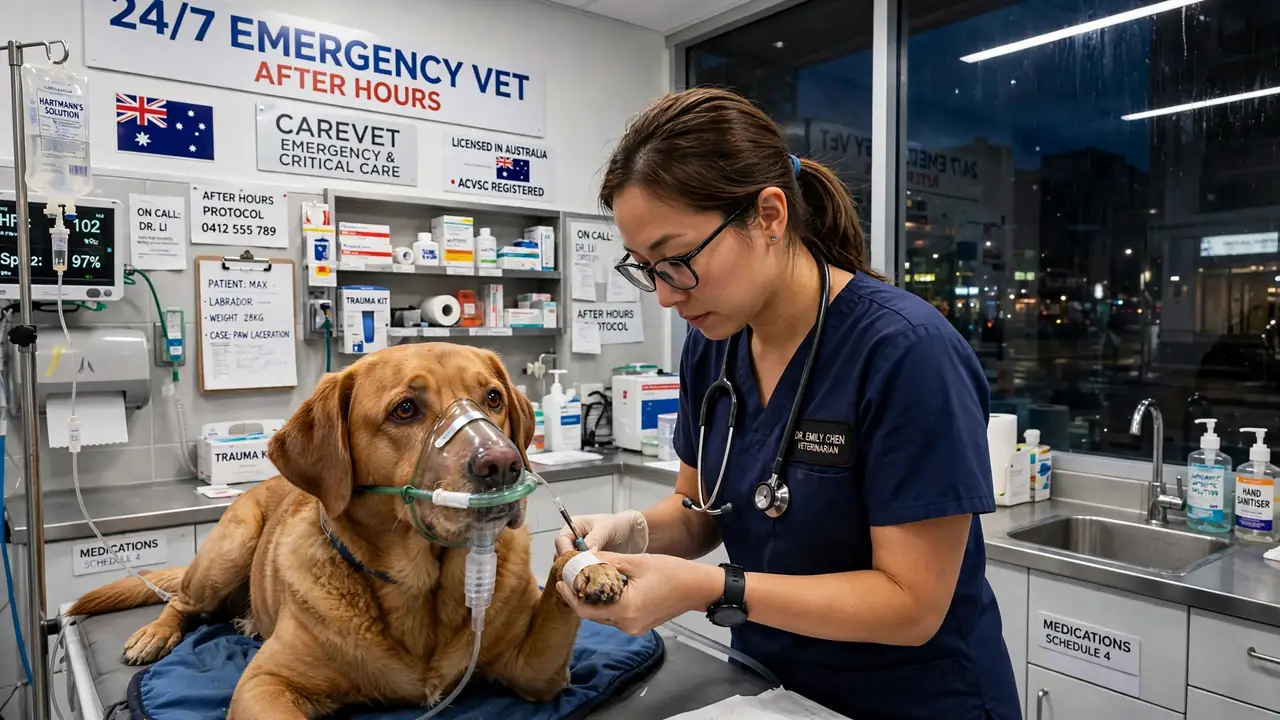
This article is general information only and not veterinary or financial advice. Prices vary by clinic, city and case complexity — always ask for a written estimate. If your pet needs urgent care, don’t delay seeking it over cost concerns; discuss payment options with the clinic. This is an emergency: see your vet now.
Nobody budgets for a 2am dash to the emergency vet — which is exactly why the emergency vet costs Australia owners face blindside so many of them. The consult alone typically runs $150–$400+, and costs stack quickly: diagnostics, treatment, surgery, hospitalisation, each billed separately. A single bad night can reach $2,000–$6,000+ before you blink. This guide gives you real 2026 price ranges for common emergencies, explains why after-hours care costs what it does, and shows you how to prepare financially so a crisis never becomes a choice between money and your pet’s life.
Why Emergency Vets Cost More: The Honest Breakdown
It’s not price-gouging — it’s economics. Emergency clinics run 24/7 with specialist-grade equipment, vets and nurses on night/weekend penalty rates, and the capacity to do surgery at 3am — a level of readiness that has to be paid for whether the night is quiet or chaotic. There’s no Medicare for pets; owners pay the true cost of care. A regular daytime consult ($70–$150 at most clinics) becomes $150–$400+ after hours because you’re paying for immediate access to a fully staffed hospital, not a booked appointment. Understanding this doesn’t make the bill smaller, but it helps you plan for it rather than resenting it mid-crisis.
Emergency Vet Costs Australia: The Price Ranges (2026)
These emergency vet costs Australia figures are approximate November 2026 snapshots compiled from Australian emergency clinic fee schedules and veterinary industry data. Your clinic’s prices will differ — use these to calibrate expectations, not as quotes.
- Emergency consultation: $150–$400+ (some specialist centres charge $350+ including public holidays)
- After-hours surcharge on top of treatment: varies; some clinics roll it into the consult fee
- X-rays: $300–$600+ depending on views and whether sedation is needed
- Ultrasound: $400–$800+ (abdominal ultrasound with specialist interpretation costs more)
- Blood tests: $150–$400+ for in-house panels; specialised tests cost more
- IV fluids and stabilisation: $300–$1,000+
- Wound repair / lacerations: $800–$2,500+ depending on severity and anaesthesia
- Emergency surgery (foreign body, GDV/bloat, fracture): $2,000–$6,000+
- Hospitalisation: $500–$2,000+ per day for intensive monitoring
- Snake bite treatment: $1,000–$4,000+ (antivenom is a major cost driver)
- Tick paralysis treatment: averages ~$2,400 per claim, with the highest claim reaching $53,331 (PetSure 2022 claims data)
- Poisoning treatment: $500–$2,000+
The pattern: the consult is just the entry ticket. Diagnostics ($300–$1,000+) and treatment stack on top, which is how a “quick check” becomes a $1,500 night. Always ask for an itemised estimate before authorising treatment — reputable clinics provide one without being asked. If the estimate shocks you, say so plainly: vets deal with cost constraints daily and can often prioritise the highest-value diagnostics first, stage treatment across steps, or discuss which components are essential tonight versus which can wait for your regular vet in the morning.
Common Emergencies and What They Typically Cost
Swallowed foreign object
Dogs eat socks, toys, corn cobs and worse. If caught early, induced vomiting at the clinic ($200–$400) may solve it. Once it’s in the intestines, you’re looking at x-rays/ultrasound ($300–$800) plus surgical removal ($2,000–$6,000+). PetSure’s 2025 claims data puts bloat (GDV) surgery at $5,223 on average; foreign-body surgery typically runs $2,000–$6,000, with complex cases far higher. Prevention — bin discipline, toy supervision — is worth thousands.
Bloody diarrhoea / severe gastroenteritis
Gastroenteritis is among the most commonly claimed conditions, with treatment often running into the hundreds of dollars — but severe cases needing hospitalisation on IV fluids can exceed $2,000. Haemorrhagic gastroenteritis in particular deteriorates fast; don’t “wait and see” with bloody diarrhoea.
Hit by car / trauma
Ranges from minor ($500–$1,500 for assessment, x-rays and wound care) to catastrophic ($5,000–$15,000+ for fractures, internal injuries and multi-day ICU). This is the scenario pet insurance exists for — see our pet insurance comparison.
Snake bite
Australian snakes make this a uniquely local emergency. Treatment ($1,000–$4,000+) hinges on rapid vet access — antivenom, hospitalisation and monitoring. PetSure’s 2025 average snake bite claim was $2,447. Every minute matters; call ahead so the clinic prepares.
Tick paralysis
Along the east coast, this is a seasonal plague. Treatment involves tick antiserum, often clipping the coat to find all ticks, oxygen support and hospitalisation — averaging ~$2,400, with the highest claim reaching $53,331 in a severe ventilated case (PetSure 2022 claims data). Year-round prevention costs a fraction of one treatment. See our tick paralysis guide.
Heatstroke
Summer emergency, entirely preventable, potentially fatal within minutes. Emergency cooling, fluids and monitoring: $800–$3,000+. Brachycephalic breeds (pugs, French bulldogs, British bulldogs) are at extreme risk.
What Happens Financially at 2am: Payment Realities
Emergency clinics generally require payment or a payment plan arrangement before or at discharge — they can’t carry thousands in unpaid bills and stay open. This surprises owners who assume vet care works like human healthcare; it doesn’t, and knowing this in advance prevents the awful 3am realisation. Sort your payment readiness now — VetPay pre-approval, insurance details on your phone, emergency fund in place — so the midnight version of you, running on adrenaline and no sleep, doesn’t have to solve finances and triage simultaneously. Your options:
- Pay in full: credit/debit. Most clinics accept cards; some don’t take cash.
- VetPay / Afterpay-style vet payment plans: many emergency clinics partner with VetPay or similar — ask upfront, as approval takes minutes and changes what’s treatable.
- GapOnly claiming: if your insurer and vet support it, you pay only the gap at the time — dramatically reducing the midnight cash needed. Check before the emergency whether your vet offers it.
- Pet insurance: most insurers reimburse after you pay (claims take days to weeks), so insurance helps with the total but not always the midnight cashflow — another reason GapOnly matters.
- Charity assistance: in genuine hardship, some charities and vet schools offer reduced-cost emergency care, but availability is limited and not immediate.
The worst outcome is a treatable pet and an unaffordable bill. Discuss payment options with your vet early in the visit, not after treatment — vets can sometimes stage diagnostics or choose between treatment paths once they know your constraints.
How to Prepare: The Pre-Emergency Checklist
- Save your nearest 24-hour emergency vet’s number in your phone now — plus a backup. In a crisis you won’t be Googling calmly.
- Keep an emergency fund: $1,000–$2,000 earmarked for vet emergencies covers most single incidents’ upfront costs. Plug the figure into our pet cost calculator to see the first-year total.
- Consider insurance while your pet is young and healthy — pre-existing conditions are excluded, so waiting until something happens is too late. Our pet insurance comparison explains what policies do and don’t cover.
- Ask your regular vet about their after-hours arrangements and whether they offer GapOnly.
- Pet-proof your home: lock bins, store medications and xylitol products securely, supervise chewers. Most foreign-body surgeries are preventable.
- Learn basic first aid: a pet first aid kit and knowing the signs your pet is in pain help you triage calmly.
Emergency vs “Can Wait Until Morning”: Quick Triage
Go now (emergency): difficulty breathing, collapse, seizures, uncontrolled bleeding, suspected poisoning, snake bite, bloat (distended hard abdomen, retching), heatstroke signs, inability to urinate (especially male cats — fatal within 24–48h), eye injuries, broken bones, any trauma — and when in genuine doubt, always err on the side of going rather than waiting until morning.
Monitor closely, vet first thing: mild single vomit with normal behaviour, minor limp bearing weight, small superficial cut, reduced appetite for under 24h in an otherwise bright adult animal.
When in doubt, call. Emergency clinics triage by phone and will tell you honestly whether to come in. A phone call costs nothing; guessing wrong costs everything.
Emergency Vet Costs Australia: Anatomy of a Real Bill
To make the ranges concrete, here’s an illustrative example of how a typical midnight emergency bill builds up. Take a Labrador that swallowed a corn cob at 9pm: emergency consult $280, x-rays $450, bloodwork $220, anaesthesia and surgical removal $3,800, overnight hospitalisation $650, medications to go home $120. Total: ~$5,520 — for one bad decision about bin security. A milder case — a cat with a urinary blockage caught early: consult $300, catheterisation under sedation $900, 48 hours hospitalisation with monitoring $1,400, bloods $250. Total: ~$2,850. And the “just a check” that wasn’t: after-hours consult $320, x-ray to rule out fracture $480, pain relief and bandaging $180. Total: ~$980 for peace of mind. None of these are inflated; they’re ordinary. The pattern to internalise: diagnostics are the multiplier. The consult gets you in the door, but x-rays, ultrasound and bloods — each entirely reasonable — are what turn hundreds into thousands. This is why asking for the itemised estimate matters: it lets you and the vet prioritise. Sometimes a staged approach (x-ray first, decide on ultrasound based on results) is medically sound and financially kinder than the full battery upfront.
Regional vs Metro: The Price Gap
Where you live changes the bill substantially. Sydney and Melbourne emergency centres typically charge 20–40% more than regional clinics for equivalent care — the AREC fee schedule (emergency consult $365.20, including public holidays) reflects a major metro specialist centre, while regional emergency consults often sit closer to $180–$250. But regional areas have their own cost: fewer 24-hour clinics means longer drives, and some regions have no after-hours service at all — your “emergency vet” is a two-hour drive, which changes triage decisions. If you’re regional, know your after-hours options before you need them, including which towns have emergency cover and your vet’s diversion arrangements. Pet owners in remote areas should discuss emergency planning explicitly with their vet: what to stabilise at home, when to drive, and what’s realistically treatable locally versus requiring referral to a city centre.
FAQs: Emergency Vet Costs Australia
How much is an emergency vet visit in Australia?
Emergency vet costs Australia start with the consultation alone, typically $150–$400+ (November 2026 snapshots), with after-hours surcharges on top at some clinics. Diagnostics ($300–$1,000+), treatment and hospitalisation are billed separately, so a full emergency visit commonly totals $800–$3,000+, and surgical cases reach $2,000–$6,000+.
Why are emergency vets so expensive?
Emergency clinics operate 24/7 with specialist equipment and staff on night/weekend penalty rates. There’s no Medicare for pets, so owners pay the true cost of care. You’re paying for immediate access to a fully staffed hospital at 3am — not a scheduled daytime appointment.
Do emergency vets offer payment plans?
Many do — most Australian emergency clinics partner with VetPay or similar payment-plan providers, and some offer Afterpay-style options. Ask about payment options early in the visit. If your vet supports GapOnly claiming with your insurer, you’ll pay only the gap upfront.
Does pet insurance cover emergency vet visits?
Yes — emergency consultations, diagnostics, surgery and hospitalisation for accidents and illnesses are exactly what comprehensive pet insurance covers (subject to annual limits, excess, sub-limits and exclusions). Note most insurers reimburse after you pay, so GapOnly support at your vet makes a big cashflow difference. Pre-existing conditions are excluded.
What is the most expensive common vet emergency?
By PetSure claims data, the most expensive emergencies run into the tens of thousands — tick paralysis topped $59,000 in 2025 claims and spinal surgery (IVDD) reached over $72,000. More typically, the expensive common emergencies are foreign-body surgery ($2,000–$6,000), cruciate repairs ($3,000–$6,000) and multi-day ICU hospitalisation.
Should I go to the emergency vet or wait for my regular vet?
Go immediately for breathing difficulty, collapse, seizures, uncontrolled bleeding, poisoning, snake bite, bloat, heatstroke, inability to urinate, or major trauma. For mild, stable issues in an otherwise bright pet, monitoring until morning is often reasonable. When unsure, call the emergency clinic — phone triage is free.
Be prepared: see our best pet insurance Australia 2026 guide, and keep your vet’s number saved in your phone. The Australian Veterinary Association’s resources are at ava.com.au.