
If you’re budgeting for a new kitten or an adopted adult, the cat desexing cost Australia vets charge is one of the first real expenses you’ll face — and one of the most worthwhile. Desexing (speying a female, castrating a male) is a routine day procedure, but prices swing wildly depending on where you live, your cat’s sex and age, and whether you use a private clinic, a shelter vet service or a subsidised program. Nationally, male cat castration averages around $207 and female speying around $379, according to Compare the Market’s 2026 analysis of publicly listed vet pricing — but individual quotes range from under $90 at low-cost clinics to over $600 at premium city practices.
This guide breaks down the cat desexing cost Australia owners face, state by state in 2026, what drives the price up or down, the best age to do it, how to find low-cost options, and what recovery actually looks like. This article is general information only and not veterinary advice. If your pet is unwell, see your vet.
Cat Desexing Cost Australia by State in 2026
The table below shows the cat desexing cost Australia figures by state, from Compare the Market’s 2026 analysis of publicly listed vet pricing. Treat these as indicative ranges — your local clinic’s quote is what counts — but they give a realistic picture of the state-by-state landscape. You can also plug the figure into our pet cost calculator to see the first-year total:
- New South Wales: Male $220–$282 · Female $384–$630. Sydney metro clinics sit at the top end; regional NSW and RSPCA NSW services ($115–$300) bring the floor down considerably.
- Victoria: Male around $275 · Female around $420. Melbourne clinics cluster near the national average; some cat-only clinics advertise lower rates for young kittens.
- Queensland: Male $140–$235 · Female $180–$410. Among the cheapest states — community vet services like the Animal Welfare League list male cats at $147 and females at $189.
- Western Australia: Male around $120 · Female around $225. Perth’s advertised prices are notably low; always confirm what the quote includes.
- South Australia: Male around $178 · Female around $405. Adelaide has a wide spread between budget clinics and full-service hospitals.
- ACT / Tasmania / NT: Fewer advertised prices — Belconnen-area quotes of $285 male / $495 female have been reported, putting ACT among the most expensive, while too few advertised Tasmanian prices exist to quote a figure.
The pattern is consistent everywhere: females cost more because a spey is abdominal surgery — more anaesthetic time, more monitoring, more skill — while a male castration is a quicker external procedure. If the price gap looks dramatic at your clinic, that’s why. It’s worth noting these are 2026 prices; always confirm the current quote before booking.
What Affects the Price? 7 Cost Drivers
Two clinics five suburbs apart can quote $150 apart for the same cat. Here’s what’s behind the difference:
- Sex of the cat. As above, speys often cost 50% or more than castrations — sometimes over double.
- Age and size. Most clinics charge extra for cats over 12 months or females on heat — the surgery is technically harder and takes longer. Desexing at the recommended 4–6 months usually gets you the base price.
- What’s included. A cheap quote may exclude pre-anaesthetic blood tests (often an extra charge — ask whether they’re included), IV fluids during surgery, take-home pain relief, an Elizabethan collar and the post-op recheck. A $470 “all-inclusive” spey can be better value than a $300 quote with $200 of add-ons. Always ask for the itemised total.
- Clinic type. Shelter and community vet clinics, university teaching hospitals and mobile desexing services run 30–50% cheaper than private practices. The vets are fully qualified; the lower price reflects subsidised overheads, not lower standards.
- Location. Inner-city Sydney and Melbourne charge the most; regional and outer-suburban clinics are usually kinder to the wallet.
- Pregnancy or cryptorchidism. A pregnant spey or a retained testicle adds surgical time and cost — your vet will flag this at the pre-op check.
- After-hours or weekend surgery. Routine desexing is a weekday procedure; requesting otherwise attracts surcharges.
Low-Cost and Subsidised Desexing Options
If the private-clinic quote is out of reach, you still have solid options — desexing is one area where Australia has genuine safety nets:
- National Desexing Network. A referral directory connecting owners experiencing financial hardship with participating vets offering reduced-cost desexing. Participating clinics list reduced prices — the Network’s recommended all-year prices are around $140 for a male cat and $250 for a female, with individual clinics varying (directory examples $70–$130 male / $155–$200 female). Eligibility criteria apply and it’s aimed at genuine need, not bargain-hunting. Note the council-funded voucher program ended 31 Aug 2026, so check current availability in your area.
- RSPCA and Animal Welfare League vet services. Most states run shelter clinics open to the public with desexing well below private rates.
- Council programs. Some local councils subsidise desexing for residents, sometimes in partnership with the National Desexing Network — check your council’s website under pet registration.
- Adopted cats. If you’re adopting rather than buying, the problem is already solved: RSPCA cats go home desexed (along with vaccinated and microchipped) with the cost folded into the adoption fee — RSPCA Victoria charges $145–$400 for adult cats (kittens $235–$400); fees vary by state, with RSPCA NSW around $150. Read our guide to adopting a rescue cat in Australia for the full picture.
When Should Cats Be Desexed? The Best Age
Most Australian vets recommend desexing at 4 to 6 months of age, and many shelters desex kittens even earlier (from 8 weeks / 1kg) before adoption. The 4–6 month window is the sweet spot: the kitten is big enough for safe anaesthesia, but the surgery happens before sexual maturity — which means before the spraying, yowling, roaming and surprise litters begin.
Female cats can come into heat as early as four months, and a single unplanned mating can produce a litter you’ll then be responsible for homing. Males that aren’t desexed before maturity are far more likely to spray pungent urine indoors, fight, roam and contract FIV through bite wounds. Earlier desexing doesn’t stunt growth — that’s a persistent myth the research doesn’t support. If your cat is already an adult, it’s still worth doing at any age; the health and behaviour benefits apply throughout life. Pair the timing conversation with your kitten’s vaccination schedule so both are sorted in the same early months.
What Happens on Surgery Day?
Desexing is a day procedure: drop off in the morning, pick up in the afternoon. Here’s the usual sequence:
- Fasting. No food from the night before (usually 10pm); water is typically fine until the morning. Your clinic will give exact instructions — follow them, because anaesthesia on a full stomach is dangerous.
- Admission and pre-op check. The vet examines your cat, confirms the surgical plan, and you sign the consent form. This is your moment to ask about pain relief protocols and what’s included in the quote.
- Anaesthesia and surgery. Your cat is fully asleep and monitored throughout — heart rate, oxygen, temperature. A male castration takes around 15–20 minutes; a female spey 30–45 minutes.
- Recovery and discharge. Cats wake in a warm, quiet recovery area. You’ll get discharge instructions, pain relief for a few days, and usually an Elizabethan collar or recovery suit.
Complications are uncommon in healthy young cats, but call the clinic if you notice pale gums, continuous bleeding, vomiting that won’t stop, or a wound that opens, swells badly or smells.
Recovery: The First 10–14 Days
Recovery is straightforward if you set the cat up for success:
- Rest, not confinement panic. Keep the cat indoors and calm for 10–14 days. No jumping marathons, no outdoor roaming. A small room works better than the whole house for the first few days.
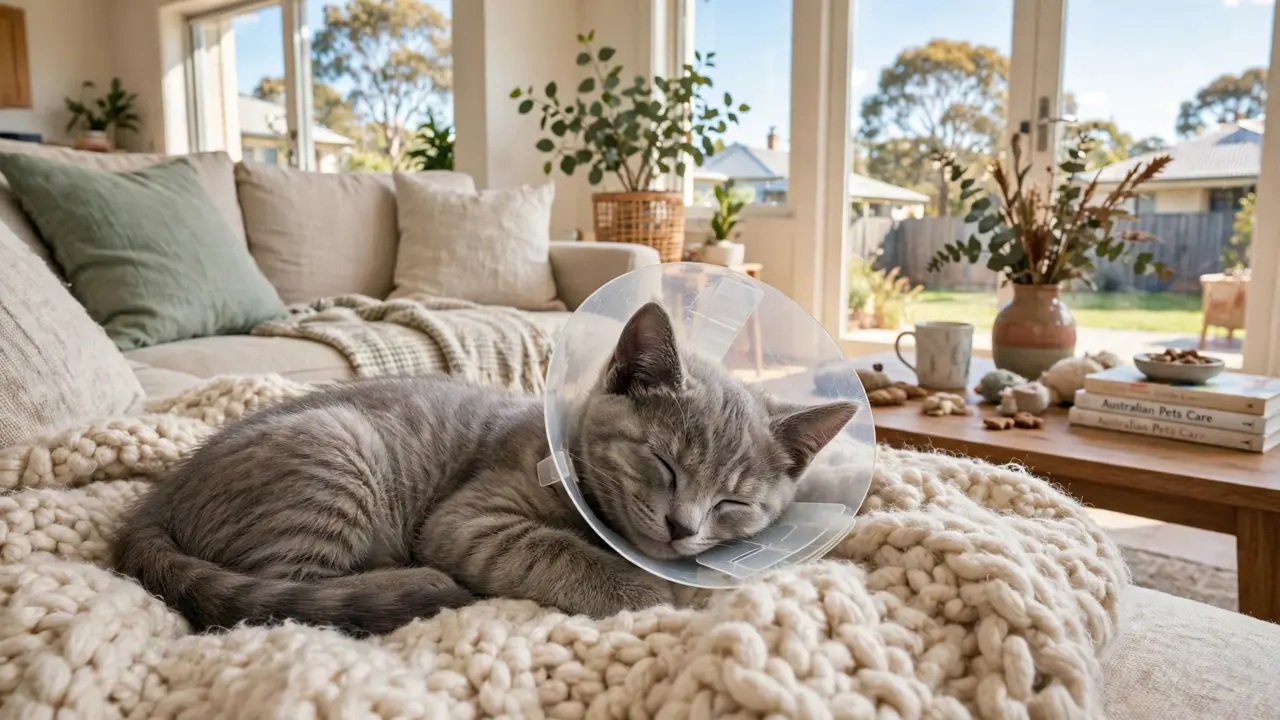
- The cone stays on. However tragic they look, the Elizabethan collar or recovery suit prevents licking, which is the number one cause of wound infections. Most cats resign themselves within a day.
- Check the wound daily. A little redness at the edges is normal; spreading redness, discharge, swelling or a bad smell is a vet call.
- Food and water. Offer a small meal the evening after surgery — appetite may be reduced for 24 hours. Then feed normally, but watch portions: desexed cats need about 20–30% fewer calories, and weight gain creeps up fast. This is a good moment to review diet — see our best wet cat food guide once it publishes.
- Litter tray. Keep it extra clean; consider paper-based litter for a few days if your vet suggests it, to keep dust out of a male’s wound.
- Follow-up. Many clinics include a free post-op recheck at 7–10 days. Go, even if everything looks fine.
Is Desexing Covered by Pet Insurance?
Generally, no. Australian pet insurers treat desexing as a routine, elective procedure rather than treatment for illness or injury, so standard accident-and-illness policies exclude it. Some insurers offer optional routine-care or wellness add-ons with a yearly allowance that can be used toward desexing, vaccinations and parasite prevention — but check the waiting periods and annual limits, because a $200 wellness benefit against a $400 spey still leaves you paying half. Desexing complications, on the other hand, are usually covered under the main policy as unexpected illness treatment. Read the PDS before you assume anything. See our guide to best pet insurance Australia 2026 for what policies do and don’t cover.
Desexing and Council Registration: The Legal Side
Desexing isn’t just good practice in much of Australia — it interacts with the law. Several states and many councils use registration fees to push desexing:
- South Australia: desexing is compulsory for dogs and cats born after 1 July 2018 — they must be desexed by 6 months of age or within 28 days of taking ownership (exemptions apply for registered breeders and on veterinary grounds).
- Western Australia: cats must be desexed, microchipped and registered with the local council in most areas; entire cats need specific permits or exemptions.
- ACT: cats must be desexed (with limited exemptions) and registered.
- Registration discounts: across NSW, VIC, QLD, SA and TAS, councils typically charge significantly lower annual registration fees for desexed cats — often half the entire-cat fee or less. Over a cat’s lifetime, the registration savings alone can cover a large chunk of the desexing cost.
- Microchipping: legally required for cats in most states, and many clinics offer discounted microchipping when done at the time of desexing (the AWL Queensland price list, for example, advertises 50% off microchipping with desexing).
Keep your desexing certificate with your registration paperwork — councils may ask for proof when you claim the desexed rate. And if you’re adopting, the rescue handles all of this: desexing, microchipping and the transfer paperwork come bundled in the adoption fee.
Getting an accurate quote
When you call clinics for prices, ask the same questions each time so quotes are comparable: Is pre-anaesthetic blood work included or extra? Are IV fluids, pain relief to take home, the cone or suit, and the post-op recheck included? Is there an additional charge for cats over 12 months or females on heat? A clinic that answers clearly and itemises willingly is usually a clinic that won’t surprise you on the invoice.
FAQs: Cat Desexing Cost Australia
How much does it cost to desex a cat in Australia in 2026?
The cat desexing cost Australia average nationally is around $207 for male castration and $379 for female speying (Compare the Market’s 2026 analysis). State ranges run roughly $120–$282 for males and $180–$630 for females; low-cost clinics charge significantly less.
Why is desexing a female cat more expensive?
A spey is abdominal surgery requiring longer anaesthesia, more monitoring and greater surgical skill, while a male castration is a shorter external procedure. The price gap — often 50% or more, sometimes over double — reflects real differences in time and complexity.
What is the best age to desex a kitten?
Most Australian vets recommend 4–6 months — old enough for safe anaesthesia but before sexual maturity. Shelters often desex from 8 weeks of age.
Are there low-cost desexing options in Australia?
Yes: the National Desexing Network refers owners in financial hardship to reduced-cost vets, and RSPCA and Animal Welfare League clinics offer desexing well below private rates. Some councils also subsidise the procedure.
How long does it take a cat to recover from desexing?
Most cats are back to themselves within 48 hours, but restricted activity and the cone or recovery suit should continue for 10–14 days until the wound is fully healed.
Does pet insurance cover desexing?
Standard policies generally exclude it as a routine procedure. Some insurers offer wellness add-ons with an annual allowance usable for desexing — check waiting periods and limits in the PDS.
Price data reflects advertised Australian clinic pricing collected in 2026 and is indicative only — confirm the current quote with your vet. Further reading: Compare the Market’s pet surgery cost analysis. This article is general information only and not veterinary advice. If your pet is unwell, see your vet.