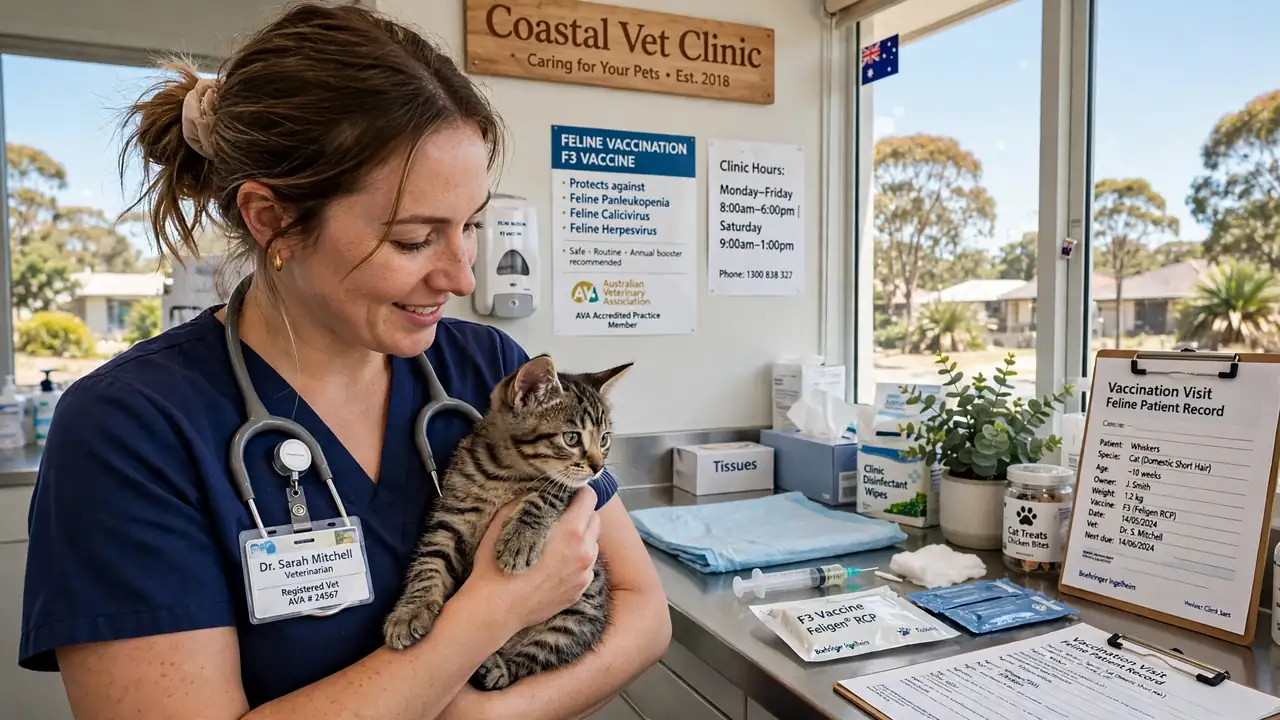
Bringing home a kitten is one of the happiest days in a household, but the kitten vaccination schedule Australia follows is the first real responsibility that comes with it. Kittens are born with some protection from their mother’s milk, but that immunity fades fast — usually by six to eight weeks of age. From that point, vaccinations are what stand between your kitten and diseases like cat flu and feline panleukopenia, which can be genuinely life-threatening in young cats.
The good news is that Australia has one of the clearest, most consistent vaccination protocols in the world for cats. Most vets across the country follow the same schedule, built around a vaccine called F3. In this guide, you’ll find the exact timing, what each vaccine protects against, what it typically costs, and the questions worth asking at your first vet visit. This article is general information only — your vet will confirm the schedule for your kitten — and it is not veterinary advice. If your pet is unwell, see your vet.
The Standard Kitten Vaccination Schedule Australia Follows
Australian vets generally recommend three doses of the core F3 vaccine, spaced three to four weeks apart, starting at around six to eight weeks of age. A typical schedule looks like this:
- 6–8 weeks: First F3 vaccination, plus a full health check. Your vet will also talk through worming, flea prevention, nutrition and settling-in advice.
- 10–12 weeks: Second F3 vaccination. The vet reviews growth, weight and behaviour, and confirms the parasite control plan is on track.
- 14–16 weeks: Third and final vaccination of the kitten course. After this, your vet will advise on safe socialisation and when boosters are due.
- Around 12 months of age: Booster vaccination, then ongoing boosters on a schedule your vet sets (often every one to three years for core vaccines, with annual health checks regardless).
Exact dates can shift a little depending on the vaccine brand your clinic uses and your kitten’s circumstances — a kitten adopted at ten weeks will simply start wherever the record shows, and the vet works from there. What matters most is not missing a dose: kittens are not considered fully protected until about two weeks after their final vaccination, so keep them indoors and away from unvaccinated cats until then. If your kitten is going through desexing at the same age, many clinics combine the discussion of both into one visit plan.
What Is the F3 Vaccine? (And F4, F5 Explained)
The standard core vaccine for Australian cats is called F3, and it protects against three serious diseases:
- Feline panleukopenia (sometimes called feline enteritis) — a severe gut and immune-system virus with a high mortality rate in kittens.
- Feline herpesvirus — a major cause of cat flu: sneezing, runny eyes, nasal congestion and ulcers. Many cats carry it for life.
- Feline calicivirus — the other main cause of cat flu, bringing mouth ulcers, drooling, fever and poor appetite.
You may also hear vets mention F4 and F5. These are not different core vaccines — they are the F3 plus one or two non-core extras: FIV (feline immunodeficiency virus, spread through cat bites) and FeLV (feline leukaemia virus, spread through close contact and shared bowls). The FIV series involves three initial doses a few weeks apart, and cats are tested for FIV before the series starts. Whether your cat needs FIV or FeLV vaccination depends on a risk assessment — outdoor cats, territorial roamers and multi-cat households are the usual candidates. Ask your vet; there is no one-size-fits-all answer.
How Much Do Kitten Vaccinations Cost?
Vaccination is one of the more affordable parts of kitten ownership, but costs vary by clinic and city. As a rough guide, a single F3 dose on the kitten vaccination schedule Australia follows typically falls between $80 and $140, and the full three-dose kitten course therefore lands somewhere in the $240–$400 range, often bundled with health checks. Community and shelter clinics (including RSPCA and Animal Welfare League services) tend to sit at the lower end, while inner-city private clinics charge more. You can tot up the rest of the first-year costs with our pet cost calculator.
A few ways to keep costs sensible without cutting corners:
- Ask about kitten packages. Many clinics bundle the three vaccinations with worming, microchipping and a desexing discount — the bundle is almost always cheaper than buying each item separately.
- Don’t skip the middle dose. It is tempting to treat the second visit as optional once the kitten looks healthy. It isn’t. The middle dose is what bridges maternal immunity fading and the final dose locking in.
- Keep the vaccination certificate. Catteries, pet sitters, landlords and interstate moves may all ask for proof. Losing it means paying for a titre test or revaccination you didn’t need.
Pet insurance with a routine-care add-on can reimburse part of vaccination costs, but standard accident-and-illness policies generally don’t cover them. Check the product disclosure statement before you buy a policy for this reason alone.
Before and After the First Vaccination: What to Expect
The first visit is as much about you as the kitten. A good vet will weigh the kitten, listen to heart and lungs, check eyes, ears and mouth, feel the belly, and ask about diet, litter habits and where the kitten sleeps. Bring any paperwork from the breeder or shelter — vaccination history, worming dates, the food the kitten has been eating. For feeding, see our guide to the best cat food in Australia. Sudden diet changes cause more tummy trouble in the first week home than almost anything else.
After each vaccination, mild side effects are normal: a little sleepiness, slightly reduced appetite, or a tender spot where the injection went in, all settling within 24–48 hours. Call the clinic promptly if you see facial swelling, vomiting, difficulty breathing, or lethargy that lasts beyond a day — true vaccine reactions are uncommon but need fast attention.
Socialisation and the vaccination window
Here’s the tension every new kitten owner feels: kittens have a critical socialisation window (roughly 2–14 weeks) when positive experiences shape lifelong temperament, but they’re not fully protected until after the final vaccination. The balanced approach vets recommend:
- Invite healthy, fully vaccinated, cat-friendly visitors to your home — human socialisation is risk-free and hugely valuable.
- Let the kitten meet one known, fully vaccinated, healthy cat after the second vaccination, supervised.
- Save parks, catteries, pet shops and unknown cats for at least a week or two after the final (16-week) dose.
- Handle paws, ears and mouth gently from day one — it pays off enormously at future vet visits and grooming sessions.
What If You Missed a Dose or Adopted an Older Kitten?
Life happens: a rehomed kitten arrives with no paperwork, or a busy fortnight turns into a missed appointment. Don’t panic, and don’t start the course over from scratch without advice — just call the clinic. Vets deal with this weekly. Generally, if only a short time has passed since the missed dose, the vet will give the outstanding vaccination and continue the schedule; if months have gone by, they may recommend restarting the course to be safe, since immunity from a single early dose isn’t reliable.
For kittens adopted older than 16 weeks with unknown history, most vets give two F3 doses four weeks apart and treat that as the primary course, then a booster 12 months later. Adult cats with no vaccination record get the same two-dose restart. Blood titre testing exists and can show whether a cat already has protective antibodies, but it costs more than a booster in most cases and isn’t accepted by catteries as a substitute for a vaccination certificate — so for most owners, revaccination is the simpler path. Whatever the situation, the fix is one phone call, not guilt. The goal is protection going forward.
Keeping track without the stress
The humble fridge magnet still works, but a phone calendar reminder set for the day before each due date works better, because clinics are often booked out a few days ahead. Ask the clinic at the first visit whether they send SMS or email reminders — many do, free of charge. And photograph the vaccination certificate the day you receive it; paper cards have a habit of vanishing into junk drawers, and a photo in your camera roll has saved many a cattery check-in.
Indoor Cats Still Need Vaccination
One of the most common questions vets hear: “My kitten will live indoors — does she really need all this?” The short answer is yes. Viruses travel on shoes, clothing, bags and visitors’ hands. Circumstances also change: a kitten may one day need a cattery stay, emergency vet hospitalisation, or a move to a multi-cat household. The RSPCA and the Australian Veterinary Association both support core vaccination for all cats regardless of lifestyle, because the cost of the disease so outweighs the cost of prevention. An indoor lifestyle lowers the need for non-core vaccines like FIV — it doesn’t remove the need for F3.
Vaccination Records, Boosters and Boarding
After the kitten course, your vet will set a booster plan. The first adult booster usually lands around 12 months of age; after that, many Australian vets move core F3 boosters to a triennial (every-three-year) schedule while keeping annual health checks non-negotiable. Non-core vaccines like FIV stay annual where they’re used. Don’t confuse the two: the yearly vet visit still matters even in years with no jab, because weight trends, teeth, kidneys and lumps get checked.
If you ever need a cattery, check its vaccination requirements early — most require F3 within the last 12 months and proof on file, and some want the booster given at least two weeks before boarding. Planning a holiday around this is far less stressful than discovering the requirement the week you fly out. For more on stress-free trips, see our guide to travelling with a cat in Australia.
Common Mistakes New Kitten Owners Make
- Assuming the breeder “did them all.” Many kittens leave the breeder with one dose only. Get the certificate and confirm exactly what was given and when the next is due.
- Vaccinating a sick kitten. Vaccines work best in a healthy immune system. If your kitten has diarrhoea, a cold or isn’t eating, tell the vet — they may delay a few days.
- Forgetting parasite control. Vaccination isn’t the whole prevention picture. Kittens need worming every two weeks until 12 weeks, then monthly until six months, plus flea prevention — your vet will set the calendar.
- Skipping the final dose at 16 weeks. Maternal antibodies can interfere with early doses, which is precisely why the course runs to 14–16 weeks. The last dose is the most important one.
FAQs: Kitten Vaccination Schedule Australia
When should kittens get their first vaccination in Australia?
Under the kitten vaccination schedule Australia follows, most vets give the first F3 vaccination at 6–8 weeks of age, followed by doses at 10–12 weeks and 14–16 weeks, then a booster around 12 months.
What does the F3 vaccine protect against?
F3 protects against feline panleukopenia (enteritis), feline herpesvirus and feline calicivirus — the two main causes of cat flu plus a serious gut virus.
How much does kitten vaccination cost in Australia?
A single F3 dose typically costs $80–$140 depending on the clinic, so the full three-dose course is roughly $240–$400. Kitten packages that bundle worming and microchipping are usually cheaper overall.
Do indoor kittens need vaccinations?
Yes. Viruses can enter the home on shoes, clothing and visitors, and circumstances change (cattery stays, vet hospitalisation, new housemates). Core F3 vaccination is recommended for all cats.
Can my kitten go outside before vaccinations are finished?
It’s safest to keep kittens indoors and away from unvaccinated cats until about two weeks after the final (16-week) vaccination, when full protection has developed.
What is the FIV vaccine, and does my kitten need it?
FIV (feline immunodeficiency virus) vaccine is a non-core vaccine recommended mainly for cats with outdoor access or bite-risk exposure. Your vet will do a risk assessment — and test for FIV before starting the three-dose series.
Sources and further reading: the RSPCA’s cat care guidance at rspca.org.au covers vaccination and kitten care in more depth. This article is general information only and not veterinary advice. If your pet is unwell, see your vet.