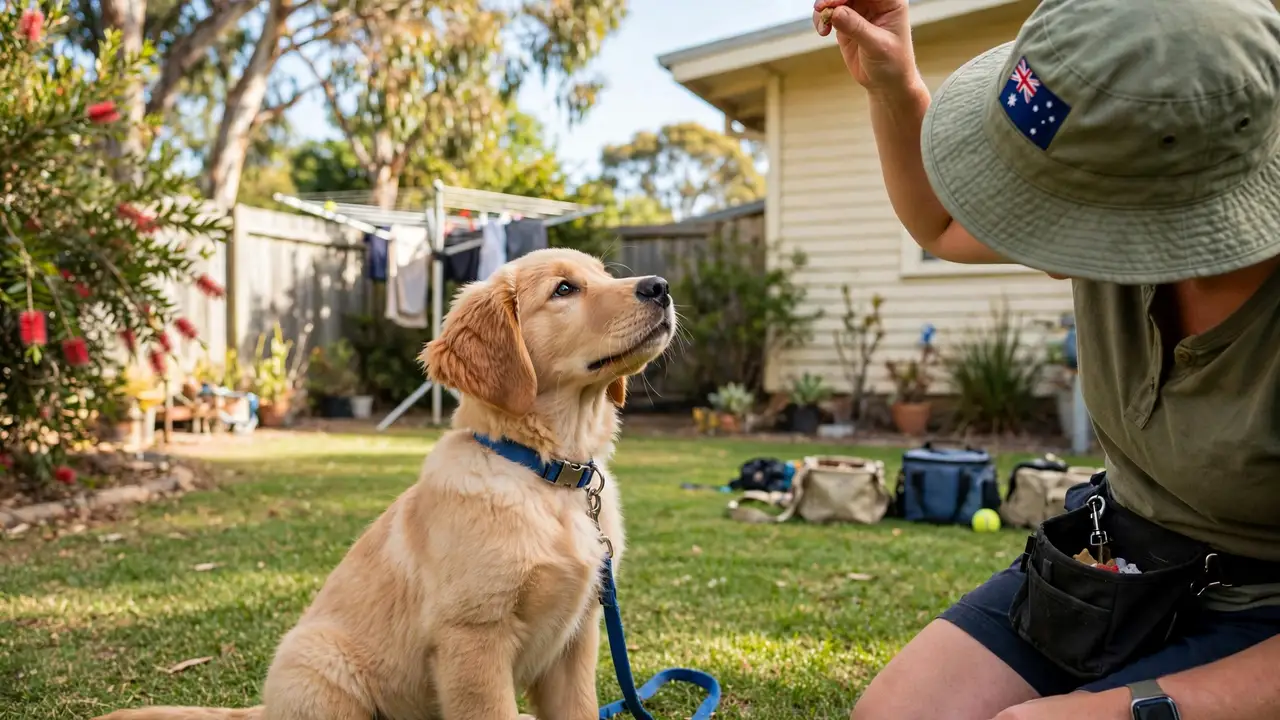
Bringing home your first puppy is equal parts thrilling and terrifying. One minute you are melting over tiny paws, the next you are Googling “why is my puppy biting me” at 2am. Looking for a puppy training guide Australia first-time owners can actually follow? This is it — no jargon, no judgement, just a clear plan for the first eight weeks that sets your puppy up for life. Training a puppy is not about dominance or tricks; it is about teaching a young animal how to live comfortably in a human household. Get the foundations right now and almost every behaviour problem people pay trainers hundreds of dollars to fix later simply never develops.
Puppy Training Guide Australia: The First 48 Hours
Your puppy’s first two days home should be boring on purpose. Everything is new — smells, sounds, the backyard, you — and a stressed puppy does not learn. Set up one small, safe area (a laundry or a sectioned-off part of the kitchen works well), put the crate, water and a chew toy in it, and let the puppy explore at their own pace. Keep visitors away for the first few days no matter how cute the photos would be; too many excited strangers in week one is a classic recipe for an overwhelmed pup.
This puppy training guide Australia plan starts gently: learn names and routines immediately. Say the puppy’s name in a happy tone and reward any glance toward you with a tiny treat. Feed at the same times each day, take the puppy to the same toilet spot after every meal, nap and play session, and keep nights calm. Most puppies cry the first few nights — that is normal, not a behaviour problem. A ticking clock or a warm (not hot) water bottle wrapped in a towel in the crate can help, and sleeping near the crate for the first week makes a genuine difference.
Toilet Training: The Non-Negotiable First Skill
Toilet training is where most first-time owners either win or lose, and the whole game is management, not punishment. A young puppy physically cannot hold their bladder long — the rule of thumb is roughly one hour per month of age, so an eight-week-old puppy needs a toilet break about every two hours, plus after eating, drinking, playing and waking up. Take them to the same spot on lead, wait quietly, and the instant they go, mark it with a cheerful “yes!” and a treat. That single habit — reward the right spot, every time — is the entire method.
Never punish accidents. Rubbing a puppy’s nose in it or shouting teaches them only to hide from you when they need to go, which makes training slower, not faster. Clean accidents with an enzymatic cleaner (Bunnings and Petbarn stock them for around $15–$25) so no scent marker remains, and ask yourself what you missed — nearly every accident is a supervision gap, not defiance. If you want the full accelerated system, our fast-track toilet training guide lays out a day-by-day schedule.
Crate Training: Your Puppy’s Bedroom, Not a Prison
A crate, introduced properly, becomes the place your puppy chooses to sleep — and it makes toilet training dramatically easier because dogs naturally avoid soiling their sleeping area. The key word is “properly”: the crate must never be used as punishment, and a young puppy should not be crated for long stretches during the day. Start by feeding meals in the crate with the door open, then close it for a few seconds, then a few minutes, building up slowly with treats and praise.
Size matters — the crate should be big enough to stand, turn and lie down, but not so big the puppy can toilet in one corner and sleep in the other (use a divider for large-breed puppies). Cover three sides with a blanket to make it den-like, and put it somewhere the family actually spends time; isolating the crate in a far room teaches the puppy that the crate means loneliness. Our step-by-step crate training guide covers the full process including night-time crying and alone-time building.
Socialisation: The Critical Window (3–16 Weeks)
The socialisation window is the single most time-sensitive part of puppy raising. Between roughly 3 and 16 weeks, puppies are wired to accept new experiences as normal; after that window closes, unfamiliar things are increasingly treated with suspicion. Under-socialised puppies become fearful adult dogs, and fear is behind most biting incidents. This does not mean dragging your unvaccinated puppy to the dog park — it means controlled, positive exposure to the sights, sounds, surfaces and people of normal life.
Aim for variety: different floor textures, umbrellas, prams, bicycles, men with hats, children at a distance, car rides, the vet clinic just for treats. Pair each new thing with food or play so the puppy’s emotional response is “new thing = good things happen”. Puppy preschool, run by most vet clinics and training schools across Australia for around $150–$250 for a 4–6 week course, is money extremely well spent — it gives safe socialisation with other puppies plus professional eyes on your technique. Keep sessions short and always end before the puppy gets overwhelmed; one calm, positive experience beats five frantic ones.
Bite Inhibition: Teaching a Soft Mouth
Puppy biting is normal — it is how they explore — but needle teeth on human skin needs a clear, consistent response. When the puppy bites too hard, let out a short, sharp “ouch”, withdraw your hands, and pause play for 10–20 seconds. Then resume. The lesson is: hard biting ends the fun; gentle mouthing keeps it going. Everyone in the household must do the same thing, because inconsistency confuses the puppy completely.
Provide legal outlets for chewing — frozen carrots, rubber toys stuffed with peanut butter (xylitol-free), and puppy-safe chews — and rotate them to keep interest up. Avoid rough hand-play games that reward grabbing at fingers. If biting is intense and constant, check the basics first: overtired puppies bite far more, and most young puppies need 18–20 hours of sleep a day. An overtired puppy is not a bad puppy; they need a nap in the crate, not more stimulation. Persistent, escalating aggression beyond normal mouthing warrants a vet check and a professional trainer — do not wait and hope it passes.
The First Vet Visit and Vaccination Timing
Training and health run on parallel tracks in the early weeks. Book a vet check within the first few days home — the vet confirms overall health, starts or continues the vaccination course (typically C3/C5 shots at 6–8, 10–12 and 14–16 weeks in Australia), discusses parasite prevention and microchipping (legally required in most states), and gives you tailored advice on diet and growth (our guide to the best dry dog food Australia 2026 covers puppy formulas by life stage). Until vaccinations are complete, balance socialisation with disease risk: carry your puppy in public places, let them meet healthy vaccinated dogs in clean environments, and avoid dog parks and heavily trafficked footpaths. Your vet will tell you when it is safe to hit the ground — usually a week after the final puppy vaccination. Use the vet visits themselves as training: bring treats, let the staff fuss over the puppy, and build the positive associations that make adult vet visits stress-free.
Basic Commands That Actually Matter
Every practical puppy training guide Australia owners follow lands on the same short list. You do not need a repertoire of party tricks — five cues cover 95% of daily life: name recognition, sit, down, come, and leave it. Train in 2–3 minute sessions, several times a day, always ending on a success. Use tiny, soft treats (pea-sized) and reward within two seconds of the behaviour — timing matters more than the size of the reward.
“Come” deserves special attention because it is a safety cue. Never call your puppy to you for something unpleasant (nail trims, end of fun); that poisons the word. Instead, practise recall as the best game in the world: call, reward hugely, release back to play. “Leave it” is the other safety essential in Australia — dropped chicken bones at the park, cane toads in Queensland and northern NSW, and baits in some areas make a reliable leave-it genuinely life-saving. Start training it at home with boring items before you need it in the real world.
Walking on Lead Without the Drag
Loose-lead walking is the skill owners struggle with most, and the mistake is practising it on the street before the puppy understands it at home. Start indoors: reward the puppy for staying near your leg, one step at a time. When the lead goes on outdoors, the rule is simple — pulling never works. If the puppy pulls, stop dead or turn around. When the lead is loose, move forward and reward. It is tedious for the first two weeks and then suddenly clicks.
Keep early walks short (five minutes per month of age is a common guideline) and let the puppy sniff — sniffing is mental exercise and tiring in a good way. A front-clip harness gives you steering without neck pressure and is kinder than yanking on a collar. And remember the exercise equation: a tired puppy is a trainable puppy, but overtired is worse than under-exercised. Match activity to age and breed — our guide to dog exercise needs by breed and age has the numbers.
Common First-Timer Mistakes to Avoid
After years of watching new owners, the same mistakes recur. Training only when the puppy is “being bad” instead of rewarding good behaviour proactively — catch them being calm and reward it. Inconsistency between family members, where one person allows couch access and another shouts about it. Expecting too much too soon: an eight-week-old puppy has the attention span of a goldfish, and that is developmentally normal. Skipping puppy preschool to save money, then spending five times more on a behaviourist at eighteen months. And the big one — comparing your puppy to someone else’s on social media. Every puppy develops at their own pace; steady, kind consistency beats every shortcut.
When to Call a Professional
Most puppy challenges resolve with consistency and time, but get professional help promptly if you see resource guarding that escalates (stiffening, growling over food or toys that intensifies), genuine fear that does not improve with gentle exposure, or any bite that breaks skin beyond normal puppy mouthing. Look for a trainer accredited with the Pet Professional Guild Australia or the Association of Pet Dog Trainers Australia who uses reward-based methods — avoid anyone who talks about dominance, alpha rolls or correction collars on puppies. The RSPCA’s position is clear: aversive training methods risk fear and aggression and are never the right choice for a young dog.
Puppy Training Guide Australia: FAQs
How long does it take to train a puppy?
Basic household manners take 4–6 months of consistent work, with adolescence (6–18 months) bringing a testing phase where training seems to go backwards. Full reliability, especially off-lead, typically takes 12–18 months. It is a marathon, not a sprint.
What is the first thing I should teach my puppy?
Name recognition and toilet training, in parallel from day one. Then sit, recall and leave it. Everything else — tricks, heelwork, fancy cues — can wait until the foundations are solid.
Should I use treats forever, or will my puppy only listen for food?
Treats are a teaching tool, not a lifelong bribe. Once a behaviour is reliable, gradually replace food rewards with real-life rewards — praise, play, going through a door, getting the lead on. This is called “fading the lure” and it is standard practice.
Is puppy preschool worth it in Australia?
Yes — it is one of the highest-value investments in dog ownership. A 4–6 week course typically costs $150–$250 and provides safe socialisation during the critical window plus professional feedback on your handling, which prevents expensive problems later.
My puppy cries all night in the crate. What do I do?
For the first week, sleep near the crate and take the puppy out for a toilet break if they cry after a couple of hours — young puppies genuinely need it. Comfort briefly without making it a party, then settle them back. Most puppies sleep through within 1–2 weeks as the crate becomes their safe den.
Reading next: more guides for new owners in our Dog Care section.
Training guidance aligns with the RSPCA Knowledgebase position on reward-based training. If your puppy shows signs of fear or aggression, consult your vet or an accredited trainer.