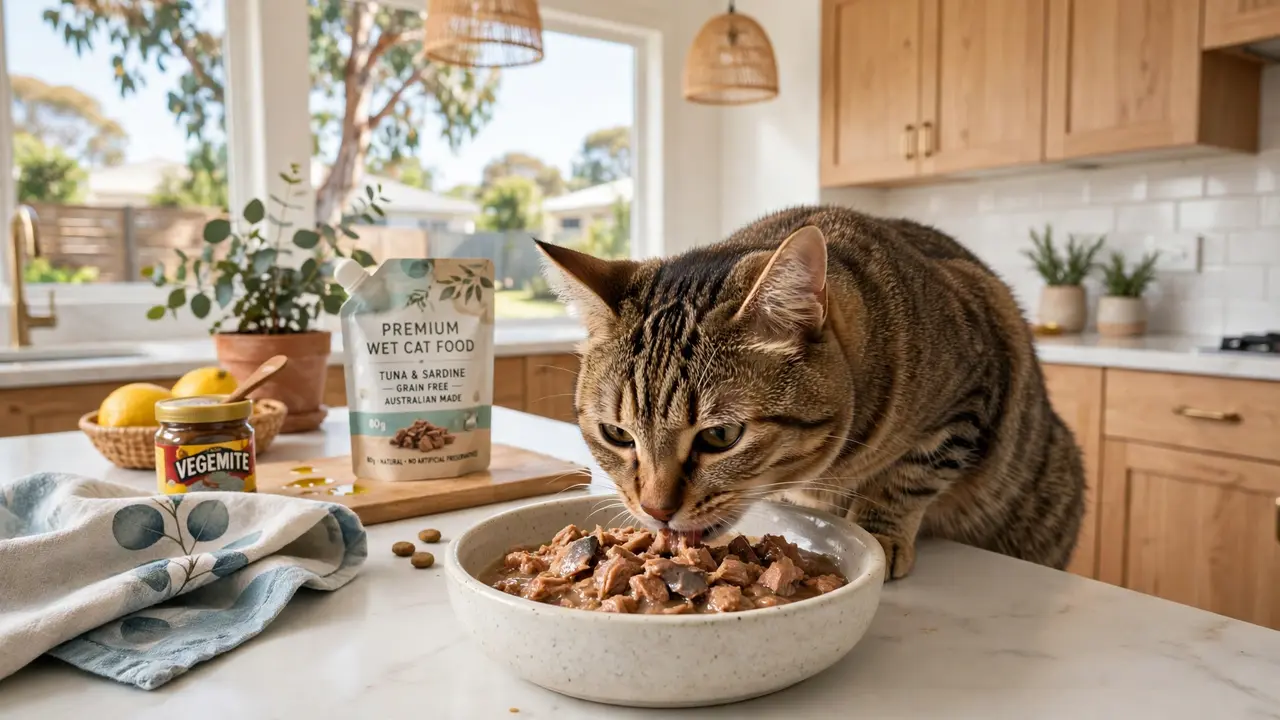
Cats are obligate carnivores — unlike dogs, they cannot thrive on plant-based diets and need meat-derived nutrients like taurine, arachidonic acid and preformed vitamin A to survive. Yet the Australian cat food aisle is full of products that obscure this with pretty packaging and vague claims. Choosing the best cat food Australia 2026 has on offer means cutting through the marketing: named meat first, adequate protein, moisture where it counts, and life-stage formulation backed by feeding standards. This guide covers the top dry and wet picks — kitten, adult, indoor and senior — with prices checked at Australian retailers in October 2026 and honest pros and cons.
What to Look for in Cat Food
The label rules for cats are stricter than for dogs because the nutritional stakes are higher. First ingredient: a named meat, meat meal or fish — “chicken”, “salmon”, “lamb meal” — not “meat and animal derivatives”. Protein: adult cats need a minimum of 26% (AAFCO), but quality foods deliver 30–40%+; kittens need 30%+ minimum. Taurine must be present (cats cannot synthesise enough) — any complete food includes it, which is why “complete and balanced” on the label matters so much. Moisture: cats evolved as desert animals with a low thirst drive, so wet food’s 75–80% moisture genuinely supports urinary and kidney health in a way dry food cannot — most vets now recommend at least some wet food in every cat’s diet.
Check for the AAFCO statement confirming the food is complete and balanced for the stated life stage. Be sceptical of “grain-free” as an automatic virtue — grains are not the enemy for most cats, and some grain-free foods substitute with legumes at similar carbohydrate levels. And watch the price-per-kilo maths: premium small bags look affordable until you calculate the monthly cost — it is the fairest way to compare the best cat food Australia 2026 has on offer. Prices below were checked at Australian online retailers in October 2026; specials move them around, so verify before buying.
Best Dry Cat Food: Royal Canin Indoor Adult
Royal Canin’s Indoor Adult is the benchmark dry food for the typical Australian house cat — and most Australian cats are indoor cats. Formulated for lower-activity indoor lifestyles, it balances protein and fat to manage weight, includes specific fibres for hairball control, and supports urinary health. At Pet Circle the 4kg bag lists at $62.99 (about $1.57/100g), and AdsPet matches that price, putting it in the premium-but-sensible bracket. The research backing is deep — Royal Canin employs veterinary nutritionists and runs feeding trials — and palatability is consistently high, which matters because the best-formulated food is useless if the cat will not eat it. Pros: research-backed, excellent for indoor weight management, highly palatable. Cons: premium price; not Australian-made.
Best Dry Food for Kittens: Royal Canin Kitten
Kittens need calorie-dense, protein-rich food with DHA for brain development and balanced calcium and phosphorus for skeletal growth. Royal Canin Kitten (4kg, $53.54 at Pet Circle, roughly $1.34/100g) is the vet-clinic standard for good reason — highly digestible, tiny kibble for small mouths, and formulated for the intense growth phase up to 12 months. Feed kitten food until 12 months (large breeds like Maine Coons benefit until 15 months), then transition gradually over 7–10 days. Budget alternative: Black Hawk Kitten (chicken and rice) lists around $36–$48 for the 2kg bag at Australian retailers such as Pets Domain — Australian-made, real meat first, and excellent value for multi-cat households.
Best Wet Cat Food: Fancy Feast / Royal Canin Pouches
For wet food, two standouts cover different budgets. Purina Fancy Feast multi-packs (from around $24 at Pet Circle) are the value champion — complete and balanced, wide flavour range, and palatability that converts even fussy cats. Royal Canin Instinctive wet pouches ($40.99 for 12 pouches at Pet Circle) offer the brand’s research-backed formulation in a moisture-rich format, with the Indoor and Adult variants matching their dry counterparts. Wet food should ideally make up at least a third of the diet for urinary and kidney health — cats on dry-only diets chronically under-consume water. If your cat refuses wet food (some kibble-raised cats do), try warming it slightly, offering different textures (pate vs chunks in gravy), and transitioning gradually rather than switching cold turkey.
Best Premium: Hill’s Science Diet and Ziwi Peak
Hill’s Science Diet is the other research giant — its Adult Indoor dry (4kg, $70.99 at Pet Circle) and Oral Care variant (4kg, $63.49 at Pet Circle) are vet-recommended staples, with published feeding-trial data behind the formulations. Ziwi Peak (New Zealand-made, air-dried and wet) sits at the luxury end — ethically sourced meats, minimal processing, exceptional ingredient quality — with prices to match (air-dried cat food sits firmly at the luxury end, with small bags priced well above mainstream brands). Ziwi is superb food; whether the price premium over Hill’s or Royal Canin buys measurably better health is unproven, but for owners who want the highest ingredient standards, it is the genuine article rather than marketing.
Best for Seniors (11+ Years)
Cats over 11 need fewer calories but more support for kidneys, joints and digestion. Hill’s Science Diet Senior 11+ (dry, around $67 for a 3kg bag at Pet Circle) is the benchmark — formulated with controlled phosphorus for kidney health, added antioxidants and highly digestible protein. Royal Canin’s Ageing 12+ range is the alternative. Senior cats should see the vet twice yearly with bloodwork — kidney disease affects a large proportion of older cats and early detection via blood and urine tests changes the prognosis dramatically. If your senior cat is losing weight, drinking more, or eating less, that is a vet visit, not a food-brand problem.
Feeding Guide: How Much and How Often
Obesity is the number-one nutritional disease in Australian cats — indoor cats especially. An average 4–5kg adult cat needs roughly 200–250 calories daily, but this varies enormously with activity, age and food calorie density. Weigh food with scales rather than scoops, follow the pack guide as a starting point, and adjust to body condition: ribs should be feelable under a light fat cover, with a visible waist from above and the side. Kittens need 3–4 meals daily; adults do well on 2 meals (wet) with or without measured dry available; seniors may prefer smaller, more frequent meals. Always provide fresh water — and consider a cat water fountain ($40–$80), which many cats strongly prefer to bowls and which measurably increases water intake. Transition foods over 7–10 days to avoid digestive upset and food refusal.
Best Cat Food Australia 2026 for Indoor Cats
Most Australian cats live indoors, and indoor formulas address their specific risks: lower calorie density for less active lifestyles, hairball-control fibres (indoor cats groom more and cannot graze grass outdoors), and urinary pH management. Royal Canin Indoor Adult (4kg, $62.99) and Hill’s Science Diet Adult Indoor (4kg, $70.99) are the two research-backed benchmarks — both manage weight, hairballs and urinary health in one formula. For wet food, the indoor variants of Royal Canin pouches ($40.99 for 12) pair naturally. The critical indoor rule is portion control: indoor cats gain weight silently, and obesity drives diabetes, urinary issues and joint problems. Weigh food, follow pack guides as a starting point, and adjust to keep a visible waist. Our indoor enrichment guide covers the activity side of the weight equation.
Best Cat Food Australia 2026 on a Budget
Premium food is ideal, but budgets are real — and a mid-range complete food beats a premium food you cannot sustain. Solid budget options: Purina One and Purina Supercoat (widely available at supermarkets, complete and balanced, real meat first in most variants — typically $15–$25 for 1.5–2kg bags); Coles and Woolworths’ premium own-brand ranges have improved markedly, with several complete-and-balanced options at sharp prices. The budget rules: the food must state “complete and balanced” (non-negotiable at any price), the first ingredient should still be a named meat, and avoid the very cheapest lines where cereals lead the ingredient list. A $20 bag of complete mid-range food fed in correct portions nourishes a cat far better than a $60 premium bag fed incorrectly — portion accuracy matters more than brand prestige.
Foods That Are Toxic to Cats
Every cat owner should know this list cold: lilies (all parts — even pollen — cause fatal kidney failure; never have lilies in a cat household), onion and garlic (damage red blood cells), grapes and raisins (kidney toxicity), chocolate and caffeine, xylitol (in some peanut butters and sugar-free products), alcohol, raw fish long-term (destroys thiamine), and dog food (taurine-deficient for cats, as noted above). Also beware pet mince with sulphite preservatives — sulphur dioxide/sulphites in some pet meats cause thiamine deficiency with serious neurological effects in cats. If your cat eats something toxic, call your vet or the animal poisons helpline immediately — do not wait for symptoms, and do not induce vomiting unless directed.
Transitioning Between Cat Foods Safely
Cats are neophobic — suspicious of new foods — and abrupt switches cause refusal, vomiting or diarrhoea. The 7–10 day transition: days 1–3: 75% old food, 25% new; days 4–6: 50/50; days 7–9: 25% old, 75% new; day 10+: 100% new. For very fussy cats, extend each stage to 4–5 days. Tricks that help: warm the new food slightly to release aroma, mix a little of the old food’s “juice” (from a wet pouch) into the new food initially, and offer the new food when the cat is hungriest (morning). Never starve a cat into accepting new food — cats that do not eat for 24–48 hours risk hepatic lipidosis (fatty liver disease), which is a genuine emergency, especially in overweight cats. If a cat refuses entirely after a gradual transition, try a different texture or flavour within the same brand before abandoning the switch — texture preference is often the real issue, not the recipe.
The rotation trick: cats are neophiliac about food presentation — rotating between 2–3 quality foods (same life stage, transitioned properly) prevents the “only eats one thing” trap that leaves owners hostage to a single product. It also hedges against recipe changes and stock issues. Keep one constant “core” food and rotate the others as variety; most cats accept rotation happily if introduced gradually, and it makes medicating via food or switching for health reasons dramatically easier later in life.
Watch the water bowl: cats on wet-food-rich diets drink noticeably less from bowls — this is normal and healthy, not a concern. What matters is total moisture intake, and wet food delivers it far better than a water bowl most cats barely visit. If your cat eats mainly dry food, a water fountain ($40–$80) measurably increases drinking in most cats — moving water triggers the drinking instinct that still bowls do not.
Finally, the best cat food Australia 2026 offers is only ‘best’ if it suits your cat — trust their condition over any brand claim — a shiny coat, healthy weight, good energy and a clean litter tray tell you the food is working, whatever the price tag says.
Frequently Asked Questions
Is wet or dry food better for cats?
A mix is ideal. Wet food provides essential moisture supporting urinary and kidney health; dry food is convenient and economical. Most vets recommend at least some wet food daily — dry-only diets leave many cats chronically under-hydrated.
How much does it cost to feed a cat per month in Australia?
Roughly $40–$80/month for one cat on premium dry food, more with significant wet food (wet feeding typically doubles food costs). Budget brands can halve it; ultra-premium like Ziwi Peak can double it. Our pet cost calculator adds up the full yearly picture for a cat — food, vet care, insurance and the rest.
Is grain-free cat food better?
Not necessarily. Cats need meat, not grain-free marketing — many grain-free foods simply swap grains for legumes at similar carb levels. Focus on named meat first and adequate protein rather than the grain-free label.
Can cats eat dog food?
No — dog food lacks sufficient taurine, arachidonic acid and vitamin A for cats, and long-term feeding causes serious deficiency diseases including blindness and heart failure. Keep species’ foods separate.
When should I switch from kitten to adult food?
Around 12 months for most cats (15 months for large breeds like Maine Coons). Transition gradually over 7–10 days, mixing increasing proportions of the adult food.
Reading next: browse our Cat Care guides and Reviews for more honest, price-checked picks.
Prices checked at Australian retailers (Pet Circle, Petbarn, Pets Domain, AdsPet) in October 2026 and may vary. Nutrition guidance consistent with RSPCA and AAFCO standards. See your vet about diet changes for cats with health conditions.